Chives, green onions, and scallions often end up in the same recipes, grow from the same family, and get used as if they're all the same thing—but they are not.
Green Onions and Scallions are essentially interchangeable, and we can resolve that quickly.
Chives are a different species entirely, with a milder, more delicate flavor that earns its own shelf space. We know this firsthand: our Seven Onion BBQ Meatloaf seasoning uses green onion, scallion, and chives all in the same mix, because even in a single dish, each one does something different.
What is the difference between chives, green onions, and scallions?
The short answer: chives are a perennial herb; green onions and scallions are young onion plants harvested before the bulb matures.
All three are from the allium family, which is why they look and smell vaguely similar, but that family relationship doesn't mean they taste the same or behave the same way in the kitchen.
Green onions and scallions (pictured in their dry form below) have a definite onion bite. The white base is pungent and sharp; the green tops are milder but still assertive. They hold up to heat, can be used raw or cooked, and contribute real onion flavor to a dish.
Chives are different. They're long, thin, hollow blades—smaller and more delicate than a scallion's stalk—and their flavor is noticeably softer. There's a hint of garlic in there, a light onion quality, but nothing that will overpower a dish. Chives are almost always used as a finishing herb or stirred into cold preparations; they lose their character quickly with heat.
The visual difference matters too. Scallions and green onions come with a distinct white end and a graduated green stalk. You can see where onion stops and herb begins.
Chives are entirely green, uniform in color, and trimmed like grass. If you're garnishing a baked potato, the long bright green flecks are chives. The sliced white rounds on your ramen are green onion.
Are scallions and green onions the same thing?
In practice, yes.
In most American grocery stores and recipes, "scallion" and "green onion" are used interchangeably, and for cooking purposes, they're identical. You can swap one for the other without adjusting quantity or technique.
The technical distinction is minor: true scallions (Allium fistulosum, also called bunching onions) never develop a bulb and stay slender from root to tip. "Green onions" can also refer to immature regular onions (Allium cepa) with a slight rounded base.
In practice, this bulb-or-no-bulb difference affects neither flavor nor cooking performance in any meaningful way. The white parts of both are sharper and more pungent; the green tops are milder and herbaceous. Use both the same way.
The one moment this distinction might matter: if a recipe calls specifically for scallions in an Asian dish (stir-fry, ramen, bibimbap), it's often referring to the bunching type, which tend to be longer and more slender. But any green onion from the produce aisle will do the job.
What do chives taste like?
Mild, grassy, and lightly oniony with a faint hint of garlic–that's the chive profile. What they're not is sharp. There's no bite, no sulfur punch, no lingering aftertaste. They're the most restrained member of the onion family, which is exactly what makes them useful as a finishing herb.
This delicacy is both their strength and their limitation. Chives add a clean, herbaceous lift to anything they're scattered over–eggs, baked potatoes, soups, seafood, dips, compound butter. But they can't stand in for onion flavor in a dish that needs it; they simply don't have enough intensity. The flavor also fades fast with heat, which is why you almost always see chives added raw at the very end or stirred into cold preparations.
For Dried Chives, this characteristic actually works in their favor. Freeze-drying preserves the mild, grassy flavor well, and the dried form rehydrates quickly in cold preparations like dips and dressings. There's no chopping, no waste, and consistent results every time.
With Freeze Dried Chives, this characteristic actually works in their favor. Freeze-drying preserves the mild, grassy flavor well, and the dried form rehydrates quickly in cold preparations like dips and dressings. There's no chopping, no waste, and consistent results every time.
Because these chives are freeze-dried rather than heat-dried, they substitute for fresh in equal amounts–no conversion math needed. These dried chives are mild, savory, and herbaceous, with that same clean allium quality as fresh, and they go straight from jar to bowl without any prep.
Can you substitute chives for green onions (or the other way around)?
Yes, with adjustments–and the direction of the swap matters more than you'd think.
Chives in place of green onions: Use only the green tops of the green onion, not the white base, which is too sharp for where you'd typically use chives. The flavor will be more assertive than chives, so reduce the quantity slightly. This works well in finishing applications—over eggs, stirred into sour cream, scattered on soup—but doesn't translate as well to cooked dishes where green onion's onion depth is the point.
Green onions in place of chives: Expect a more pronounced onion flavor. Use the green tops and reduce the amount. For cold dips, dressings, and spreads, the stronger flavor can tip the balance, so start with half the called-for amount and adjust. For garnishing, sliced green onion rounds can fill in for chives visually and flavored acceptably, though the bite is sharper.
If you have neither:Dried Chives are often the more practical answer here than reaching for fresh green onion, especially in dips, spreads, and dressings. The dried form keeps indefinitely and delivers consistent herb flavor without the prep. For cooked applications that need actual onion punch, the white part of a leek, thinly sliced shallot, or finely minced yellow onion will do what neither chives nor scallion greens can.
For us, the substitution question cuts to the heart of why we use all three distinctly. Our Seven Onion BBQ Meatloafseasoning packet uses green onion, scallions, and chives all in the same mix. They're not there for redundancy: the green onion and scallions build the assertive, savory backbone; the chives add a lighter, herbaceous note that lifts the whole blend at the finish. Swapping any one for another would measurably shift the flavor. It's a full Spice & Easy meal kit—just add ground beef, breadcrumbs, eggs, and water, then glaze with Midwestern Sweet BBQ Sauce.
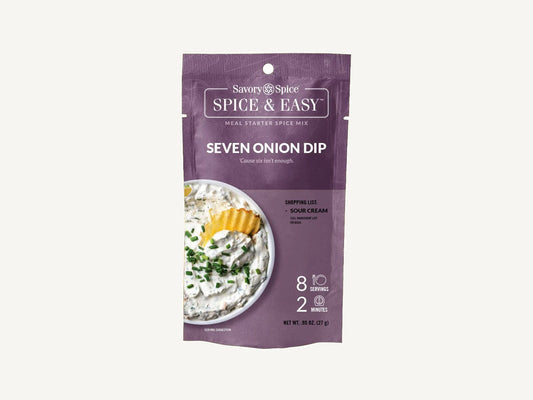
Our packet for Seven Onion Dip Mix works the same way, building depth from multiple layers of green onions, chives, and other members of the onion family rather than relying on a single one.
The most practical use case for Dried Chivesis any cold preparation where you'd normally reach for fresh, such as dips, dressings, compound butter, cheese spreads, sour cream toppings. They rehydrate in the liquid or fat base within minutes, deliver clean herb flavor, and eliminate the prep of washing and chopping a bunch of fresh chives every time.
Unlike conventional dried herbs—where the standard rule is 1 teaspoon dried for every 1 tablespoon fresh—Freeze Dried Chives substitute in equal amounts. Freeze-drying preserves the cell structure and volume of the herb in a way heat-drying doesn't, so you use the same quantity you would use fresh. Add dried chives to hot dishes near the end of cooking rather than at the start. They don't need long to bloom, and they'll lose brightness if overheated.
Dips, dressings, and sauces are where dried chives truly thrive, which is why they anchor a classic in our catalog.
Our recipe for Grand Dill Dip uses 1 Tbsp of Freeze Dried Chives in a cream cheese, sour cream, and mayonnaise base built around Dill Dip Mix and Minced Garlic. It's the kind of dip that disappears at any party. It's creamy and herbaceous, pairs well with bread or a fish entrée, chill for an hour before serving and it's ready. The chives weave a light fresh-onion thread through the richness without competing with the dill.
Additionally, our recipe for Creamy Dill Pickle Ranch Sauce calls for 2 Tbsp of Freeze Dried Chives alongside Big Dill Pickle Seasoning, sour cream, buttermilk, and lemon. The chives carry the fresh herb element in a dip built around bright, tangy flavors. Everything goes into one bowl, stirs together in five minutes, and sits in the fridge until you're ready to serve. Pair it with fried pickles, pretzels, or Zesty Dill Pickle Wings.
Fresh chives earn their place whenever you want visible flecks of green, aromatic presence on the plate, or a structural herb element built into a recipe itself. Finishing a bowl of soup or potato gratin with a scatter of fresh chives is the classic use, but there's a more interesting application worth knowing.
Fresh chives can be kneaded directly into pasta dough, where they contribute both flavor and color throughout every bite. This recipe for Fresh Chive Pasta with Asparagus Cream Sauce rolls finely chopped fresh chives and Dill Weed into hand-rolled noodles, then pairs them with a goat cheese cream sauce seasoned with Tarragon Shallot Citrus Seasoning, roasted red pepper, and toasted pine nuts. The chives show up in the pasta itself as green speckles through the dough. It's not a garnish, but part of the structure of the dish. It looks impressive and it's more approachable than it sounds: the pasta needs no machine, just a rolling pin and 30 minutes of rest time.
Fresh chives also belong on: deviled eggs and egg salad (add right before serving), smoked salmon or gravlax (with crème fraîche and capers), vichyssoise and potato soups, and any compound butter destined for steak or grilled fish. They're always a finishing move—scissor-snipped directly onto the plate from a bunch in a glass of water, like any other cut herb.