Dried Basil often gets dismissed as generic. It's the jar that sits next to the dried oregano and never gets used because fresh is supposedly always better. That framing undersells what dried basil actually does well.
It's a background herb: it deepens sauces, seasons proteins, and rounds out spice blends in ways that don't announce themselves. The California vs. European split of basil types we carry is where it gets more interesting. These have two distinct flavor profiles that behave differently depending on what you're cooking.
What is basil?
Basil (Ocimum basilicum) is a member of the mint family, native to India, where it's been cultivated for over 5,000 years. Despite there being more than 150 known varieties, the culinary world works primarily with two: sweet basil and Thai basil. Thai basil, with its licorice notes and slight bitterness, often shows up in Southeast Asian cooking, particularly in pho and Thai stir-fries. Sweet basil is the one used in Italian and Mediterranean cooking. Both varieties we carry are sweet basil.
Dried sweet basil has a warm, sweet, slightly peppery flavor with mild anise undertones. The drying process concentrates some notes and mutes others, particularly the bright, almost grassy freshness that makes fresh basil distinct. What remains is a versatile herb that seasons without dominating. When stored in an airtight container in a cool, dark place, dried basil holds for up to three years, though flavor fades over time.
The simplest test: rub a pinch of dried basil between your fingers and smell it. If it smells dusty or barely registers, it's time for a fresh jar.
What's the difference between California Basil and European Basil?
Both are sweet basil varieties, but with distinct flavor profiles that make them behave differently in the kitchen.
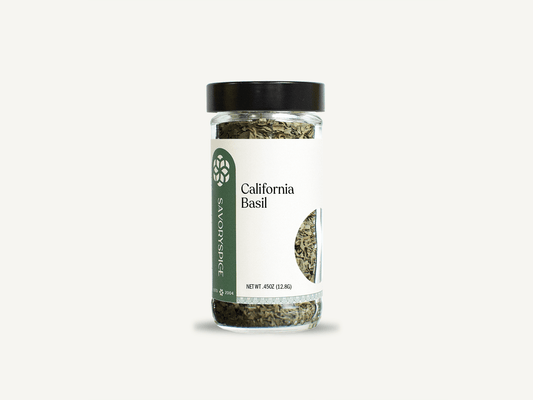
California Basil is stronger. It's warmer, sweeter, and more pronounced in its anise notes. It's the one to reach for when you want basil to be a perceptible flavor in the dish: tomato sauces, Italian sausage, hearty pasta, seafood, eggs. The advanced dehydration process we use preserves both the flavor and color at peak freshness, which is why this is widely considered one of the better dried sweet basils available. California basil pairs well with cilantro, marjoram, parsley, and oregano.
European Basil is milder and mintier, with a more delicate, slightly astringent quality. It plays a supporting role rather than a lead. It adds herbal depth to dishes without announcing itself. It pairs well with chives, garlic, mint, and thyme, and it's the basil in our Italian seasoning blends that contributes the subtle background sweetness. When you want basil woven into a blend without overpowering everything else, European is usually the right call.
These two varieties of sweet basil can be used together for a richer, more complex basil flavor, and several of our blends take exactly that approach.
The obvious answer is Italian and Mediterranean cooking. Basil belongs in tomato-based pasta sauces, on pizza, in caprese, and in virtually anything that starts with olive oil, garlic, and canned tomatoes.
California Basil in a simple marinara brings forward sweetness that balances acidity. Our Pizza Herb Topper (a blend of both basil types, oregano, thyme, garlic) is built for exactly this: sprinkle it on pizza before or after baking, blend it into pasta sauce, or use it as a seasoning base for garlic bread.
Cantanzaro Herbs takes the Italian profile further, pairingEuropean Basilwith lemon peel, garlic, marjoram, thyme, rosemary, and oregano. It's useful anywhere you want Italian herb depth with a brighter, more aromatic edge.
Beyond Italian cooking, basil is more broadly useful than its reputation suggests. It seasons fish and seafood naturally. Add a pinch of California Basil to a simple butter or olive oil pan sauce for salmon or white fish. Eggs take basil as a seasoning really well: try a 1 tsp of dried basil stirred into scrambled eggs with Parmesan, or an omelet with sun-dried tomatoes and basil. Chicken and poultry benefit from dried basil when its used in marinades and dry rubs.
It also holds up in long-cooked dishes in unexpected ways. The sweetness in California basil balances heat and acidity in beef chili in a way that doesn't read as Italian. It simply rounds out the spice profile.
Our recipe for Classic Vegetable Soupuses a pinch of California Basil to the mix and to enhance the vegetables' natural sweetness while adding depth to the flavor.
On the pizza side, our recipe for a Spicy Margherita Flatbread uses Pizza Herb Topper as the seasoning layer with fresh basil as the finishing garnish. The combination of dried basil cooked into the flatbread and fresh basil added at the end gives you both depth and brightness in the same bite.
The standard conversion is 1:3—one teaspoon of dried basil for every tablespoon of fresh.
Dried basil is more concentrated, so less goes further, though the result won't be identical, particularly in dishes where fresh basil is meant to be seen rather than cooked in.
Where dried substitutes well: cooked sauces, soups, stews, marinades, rubs, and any application where basil is working into the food over heat. Where it doesn't hold up as well: raw preparations where fresh basil's bright, green character is part of the dish, such as caprese, salads, torn over finished pasta. In those cases, the drying process removes exactly what the recipe is relying on.
Can you make pesto with dried basil?
You can, with caveats. Dried basil pesto will be darker. The flavor will be earthier and slightly more bitter.
The bright green of traditional pesto comes from fresh basil leaves. It functions best when used in cooked applications: stirred into a cream sauce, blended into a pasta toss, or used as a seasoning base rather than a standalone sauce.
For a shortcut to real pesto flavor without making pesto, our Parmesan Pesto Seasoning is a powdered blend of California Basil, Parmesan and romano cheese, garlic, and salt. It delivers genuine pesto flavor in dry form. It's useful on pasta, cream sauces, chicken, salmon, and roasted vegetables.
Our recipe for Pesto Spaghetti Carbonara uses it as the base: Parmesan Pesto Seasoning and Italian Herbs blended into olive oil, then tossed with pasta, bacon, egg, and green peas. Before you know it, you've got pesto carbonara in about 30 minutes without a blender or fresh basil required.
Because basil is a member of the mint family, substitutes are fairly accessible.
Greek Oregano is the most common swap. It carries the same Italian cooking associations and handles most of the same applications, though it's earthier and more bitter. Marjoram is milder and closer in sweetness to basil, making it a better match in more delicate dishes. Mint shares the minty quality of European basil and works in Mediterranean contexts. Tarragon has similar anise notes to California basil and can substitute in egg dishes and light sauces.
The easiest shortcut if you run out of dried basil is anItalian Herbs blend. In any recipe that calls for dried basil as part of a broader Italian herb profile, a spoonful of Italian Herbs covers the basil and most of the supporting seasoning at the same time.