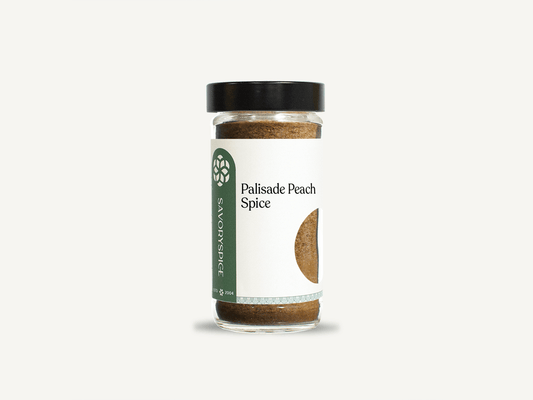
There's a window every August, a few weeks at most, when Colorado peaches are at their absolute peak: where juice runs down your arm before you can get the peach to your mouth. Sweet, floral, barely tart, with flesh dense enough to hold up on a grill or in a pie without turning to mush. Palisade Peach Spice was built to capture that.
The blend is built on a vanilla bean sugar base with warm cinnamon, bright lemon peel, cloves, and allspice. It has a way of making peaches taste more like the best peach you've ever had. It works in cobblers, crumbles, cocktails, pork glazes, and anything else summer throws at you.
In the past, this blend used to go by another name: "Georgia Peach Spice," which was a nod to our former spice shop location we had in Atlanta's Virginia-Highland neighborhood. Georgia grows such exceptional peaches, that they're basically ubiquitous to the culture there.
However, fewer people outside of Colorado know that Palisade peaches carry the same kind of regional pride (and flavor) out here, the kind that locals plan their entire August around. So as we continues to grow into our Colorado roots, we wanted to give this blend a new name that honored where we actually come from, and to give Palisade its shine. It sits just a few hours west of Denver, and every August it earns that reputation with the world-famous Palisade Peach Festival.
Palisade Peach Spice is a sweet spice blend built on a vanilla bean sugar base with warm, citrus-forward notes from cinnamon, lemon peel, cloves, and allspice. This blend works best by amplifying the natural sweetness and fragrance of fresh peaches while adding the kind of warm, spiced depth that makes a dessert taste like it came from a real kitchen.
The closest reference point most people reach for is cinnamon sugar, but this peach seasoning goes much further. Where cinnamon sugar is one-dimensional, this blend adds vanilla bean richness, a bright pop of lemon peel, and the floral warmth of cloves and allspice. It's sweet, citrusy, and warm all at once. And because the base is sugar, it dissolves beautifully into batters, sauces, cocktails, and dry rubs alike.
Another useful contrast: Pumpkin Pie Spice works because the spices do most of the heavy lifting. Pumpkin on its own is mild, and the blend is what gives the season its flavor.
But, Palisade Peach Spice works the opposite way. The peach is already doing the work. This blend is built to get out of the fruit's way and make what's already exceptional about a ripe peach louder, brighter, warmer, and more like itself.
The blend starts with real vanilla beans AND vanilla extract for a layered, genuine vanilla character that cheaper spice blends skip entirely. Sugar forms the base, which makes it easy to use: it incorporates well into batters without clumping, dissolves into liquids, and caramelizes beautifully on the grill or under a broiler.
Lemon peel and citric acid are this sweet blend's secret. Peaches have a natural brightness that's easy to lose when you cook them down. Those two ingredients hold that lift in place, keeping the flavor tasting like fresh fruit even in baked applications. The cinnamon, cloves, and allspice add the warm backbone that rounds everything out and makes it feel like a complete, finished spice rather than a sweetener.
Built by Savory Spice founder Janet Johnston to bottle the best peach of the season and make it available year-round. And the result is a blend where every ingredient earns its place.
What Are Palisade Peaches?
Palisade peaches are a category of freestone peaches grown in and around the town of Palisade, Colorado, located in Mesa County on the state's Western Slope. The region sits at roughly 4,700 feet elevation in the Grand Valley, where the Colorado River runs through a wide, flat basin flanked by red mesa walls that trap heat and block cold air. That geography makes it one of the few places in Colorado where stone fruit can grow commercially, and it turns out to produce some of the best peaches in the United States.
The name "Palisade peach" refers to the geography more than a single variety. Orchards in the region grow several freestone peach varieties–including Reliance, Contender, and Redhaven, among others–that ripen at slightly different times across the season. What they share is the terroir of that particular valley: the soil, the sun, the temperature swings, and the irrigation from mountain snowmelt.
When is Palisade Peach Season in Colorado?
Palisade peach season runs from late July through early September, with peak availability typically falling in August. The season is short by design. The same growing conditions that make these peaches exceptional also limit how long they're available. Early varieties start coming in around the third week of July; late-season varieties carry the season into the first week of September in a good year.
The Palisade Peach Festival, held annually in Palisade, CO each August, draws visitors from across Colorado and beyond. It's an entire weekend built around eating, celebrating, and taking home as many boxes of fresh peaches as the car will hold. For Coloradans, it marks the true height of summer in the same way that the 4th of July or the first day of football season does elsewhere.
Outside of Colorado, Palisade peaches occasionally appear at local farmers markets and specialty grocery stores in neighboring states during peak season, but they're not a nationally distributed product. If you're not in the region during August, Palisade Peach Spice is genuinely the best way to access the flavor year-round.
What Makes Palisade Peaches Different From Georgia Peaches?
Three main things separate Palisade peaches from most of what you'll find at a grocery store: the climate, the soil, and the way they're harvested.
The Grand Valley runs hot and dry during summer, with daytime temperatures regularly reaching the mid-90s. At night, temperatures drop 30 to 40 degrees as cold air drains down from the surrounding mesas. That daily temperature swing is one of the key factors behind the peaches' exceptional sweetness. Warm days push the fruit to produce sugar through photosynthesis; cool nights slow the ripening process, giving the sugars time to concentrate rather than metabolize away. The result is a peach with noticeably higher Brix (sugar content) than varieties grown in humid, consistently warm climates.
Palisade peaches are typically tree-ripened and sold locally or regionally, which means they're picked at or near peak ripeness rather than weeks early to survive cross-country shipping. A peach that ripens on the tree is a fundamentally different fruit than one that finishes ripening in a distribution warehouse.
The comparison people reach for most often is Georgia peaches. Georgia peaches are genuinely exceptional, and their cultural reputation is well-earned. The difference comes down to climate. Georgia's humid subtropical summers produce peaches with more moisture in the flesh and a brighter, more acidic flavor profile: a juicy softness that makes them extraordinary for eating fresh out of hand.
Palisade peaches, shaped by dry heat and cold nights, tend to be sweeter and less acidic, with denser flesh that holds its shape on the grill or in a baked application and a concentrated sweetness that comes directly from that daily temperature swing. Neither one is "better" than the other, they're just different fruits shaped by different growing conditions. But if you want to understand why Colorado takes its peaches as seriously as Georgia does, visiting Palisade in August is the answer.
How Do You Use Palisade Peach Spice in Baking?
Palisade Peach Spice is perfect for baking. The sugar base makes it behave like a spiced baking sugar. You can substitute it directly into recipes that call for sugar plus separate spices, or add it to existing recipes as a flavor amplifier. As a general rule, start with 1-2 tablespoons per recipe and adjust from there.
The most intuitive use is in any recipe that features fresh or frozen peaches. Toss sliced peaches with seasoning before adding them to a cobbler, crumble, pie filling, or muffin batter, and the blend amplifies the peach flavor while adding warm spice depth. It works equally well with frozen peaches in the off-season, as the blend picks up where fresh fruit's intensity leaves off.
It also works as a finishing touch: dust it over a scoop of vanilla ice cream, stir it into whipped cream, or use it to rim a glass for a cocktail or mocktail. The vanilla bean and citric acid components mean it dissolves cleanly and tastes bright rather than muddy.
In our recipe for Peach Crumble Pie, you can use fresh or frozen peaches, with our peach spice blend both being added in the filling and the crumble topping. Serve warm with vanilla ice cream right out of the oven.
Our recipe for our classic Spice Shop Cobbler was created by co-founder Janet Johnston. Peaches are coated in a spiced honey-lime paste, baked in individual ramekins, and topped with a buttery biscuit crumble.
Spice Shop Cobbler
Recipe by Janet Johnston, Savory Spice founder
Sweet peaches get a peppery and heavily spiced twist with the use of our Palisade Peach Spice.
Or you can try our recipe for Palisade Peach Spice Cake, a streusel cake perfect for ripe peaches in late summer season, or sweet frozen peaches year-round.
Palisade Peach Spice Cake
Recipe by Adapted from Dia S. by Ashlee Redger
A streusel cake ideal for ripe peaches in late summer or sweet frozen peaches year-round.
Yes, and this is the angle most people underestimate. Because the blend leads with vanilla and warm baking spices, it's easy to assume it lives entirely in the dessert column. But the same sugar, citrus, and warm spice profile that works in a cobbler is also exactly what makes a great pork glaze, a fruity BBQ sauce, or a grilled chicken marinade.
Pork is the most natural pairing with this peach seasoning. The sweetness of the blend cuts through fatty pork belly or shoulder, and the citric acid in the blend acts as a light tenderizer. Mix a tablespoon or two into a dry rub for pork ribs or tenderloin alongside a little Smoked Spanish Sweet Paprika and Whiskey Barrel Smoked Black Pepper, and the result is closer to a competition BBQ rib than it sounds. Using it to season a pork chop and make a quick pan sauce of chicken stock, butter, and a splash of apple cider vinegar is a 20-minute weeknight dinner worth repeating.
Chicken works just as well. Bone-in thighs or drumsticks glazed with a mix of peach spices, olive oil, and a little soy sauce caramelize beautifully on the grill, picking up char on the outside while the inside stays juicy.
For BBQ sauce, Savory Spice co-founder Janet Johnston grew up eating her father's famous peach BBQ sauce. Woody's recipe has been in the family for decades. Pureed peaches, apple cider vinegar, ketchup, soy sauce, brown sugar, and Palisade Peach Spice. Just mix and refrigerate for 30 minutes. Use it on ribs, pulled pork, or grilled chicken thighs. It will have guests asking you for the recipe!
Woody’s Peach BBQ Sauce
Recipe by Adapted from a recipe of Savory founder Janet’s dad, Woody Chambers
Savory Spice founder Janet C. Johnston grew up on her dad's peach BBQ sauce. Janet's dad, Woody, shared his easy...
Beyond the grill and the sauce pan, Palisade Peach Spice has a way of turning the peach itself into the centerpiece—whether that's on a grill grate or straight out of a pizza oven.
Summer Peach Neapolitan Pizza
Recipe by Savory Spice Test Kitchen
Fresh peaches, basil, and Palisade Peach Spice meet sweet vanilla mascarpone sauce in this summer-inspired dessert...
Yes, and the sugar base is what makes it work so well. Because Palisade Peach Spice is built on a vanilla bean sugar foundation rather than a straight spice blend, it dissolves cleanly into liquids without clumping or leaving a grainy texture. That makes it a natural fit for cocktails, mocktails, lemonades, and anything else you'd want to shake or stir.
The most direct application is as a cocktail sweetener and seasoning in one. Instead of making a separate simple syrup, you can muddle this blend directly with fresh fruit and citrus. The sugar will dissolve into the juice and the spices infuse the whole drink as you shake it. It also works to sweet cocktail rimmer on a glass: mix with a little sugar on a flat plate and press the rim in after running a citrus wedge around the edge.
For non-alcoholic drinks, stir a teaspoon into lemonade, peach iced tea, or sparkling water with a squeeze of tangelo for a quick spiced peach soda.
Palisade Peach Blossom Cocktail
Recipe by Shantelle Stephens
This is the perfect cocktail for peach season. It's refreshing and sweet, spiked with a sugar-based seasoning...
Stone fruits across the board. Apricots, nectarines, plums, and cherries all pair naturally with the warm spice and vanilla profile of this blend. That makes sense, because stone fruits share similar flavor chemistry: floral, sweet, and slightly tart, with enough natural sugar to caramelize and enough acid to stay bright.
Apricots are the closest swap to peaches. They're slightly more tart and less juicy, which means they can handle a heavier hand with the blend. A tablespoon per pound of apricots in a crumble or galette works well.
Nectarines are essentially smooth-skinned peaches and behave almost identically in any recipe that calls for peaches. Substituting nectarines in your peach pie or cobbler recipe requires no adjustments.
Plums have a deeper, more wine-like flavor that plays nicely against the cinnamon and clove notes. A plum galette with a dusting of the blend is a good late-summer option when peach season is winding down.
Cherries pair especially well with the vanilla bean base. Cherry crisp or a cherry-almond cake with this peach blend folded into the topping adds a warm, fragrant note that straight cinnamon sugar doesn't.
Outside of stone fruits, ripe mango and pineapple work in applications where you want a tropical-warm direction, particularly in drinks and grilled preparations.