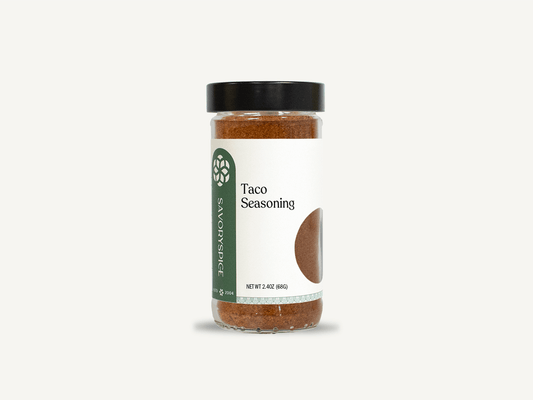
Taco Seasoning is one of those ingredients most home cooks have never really tasted on its own–not freshly ground, anyway. Most grocery store packets are overloaded with salt, and have cumin and chile somewhere even lower down the ingredient list.
We handcraft ours in small batches with freshly ground chiles, real cumin, Mexican oregano, roasted garlic, and tomato powder–spices you can actually taste, because the sodium isn't the star here. We use masa harina to help thicken the sauce the way it does in traditional Mexican cooking. For under $7 a jar, one jar can do what three store-bought packets do. Plus, our customers and home cooks consistently say it's the best taco seasoning they've ever tasted. We'll let that speak for itself.
What is Taco Seasoning made of?
Our blend of Taco Seasoning has eleven ingredients: masa harina, salt, chiles, tomato powder, garlic, cumin, California paprika, onion, white sugar, Mexican oregano, and allspice. Every one of them is a real ingredient. There are no fillers, anti-caking agents, preservatives or sodium overload.
The ingredient you might not recognize is masa harina. It's ground, nixtamalized corn–the same base ingredient as corn tortillas–and it does two things in this blend. It contributes a mild, toasty corn flavor that deepens the overall profile, and it thickens the sauce when you add water during cooking, creating that characteristic saucy taco meat consistency that a dry spice blend alone can't produce. It's also what makes this seasoning naturally gluten-free in addition to being low in sodium.
Speaking of the sodium, the salt content of our taco mix is notably lower than commercial taco seasoning packets, which typically use salt as a primary filler. Our blend still contains enough salt to season meat, but it doesn't have the sharp, over-salted edge that store-bought packets of taco seasoning are typically known for. For anyone watching sodium intake, that distinction matters.
On value: a standard grocery store packet holds about 2 tablespoons, enough for 1 pound of meat. Our jar holds roughly 7 tablespoons–roughly the equivalent of 3 to 4 packets–for under $7. Shop 70 other spices and blends also $7 or less in our collection of Savory Savings products.
What does Taco Seasoning taste like?
The flavor of our Taco Seasoning earthy and savory first, then aromatic. Cumin is a dominant note, with the slightly smoky-sweet depth of California paprika underneath it, and Mexican oregano adding a herbal brightness that's more citrusy and floral than the Italian or Mediterranean oregano found in most American pantries. Chiles contribute a mild, well-rounded heat–not sharp peppery heat, but a warm glow that builds slowly.
Allspice is the ingredient that makes our blend harder to replicate from scratch. It contributes a warm, spiced quality that helps give this taco spice blend its recognizable character without being identifiable as a distinct flavor. Pull it out and the blend tastes flat; leave it in and the overall profile reads as complete.
The flavor is mild and family-friendly by design. The chiles in the blend are chosen for depth, not heat, so the result is bold and deeply savory without the burn that puts off kids or heat-sensitive eaters. If you want more heat, add chile powder, cayenne, or hot sauce at the table rather than reaching for a spicier blend.
How much Taco Seasoning do you use for 1 pound of meat?
The standard method: brown 1 pound of ground beef (or turkey) until just cooked through, drain the fat, then add 4 tablespoons of taco seasoning and 1 cup of water. Cover and simmer over medium-low heat for 10-15 minutes, stirring occasionally, until the liquid absorbs and the meat thickens into that characteristic saucy consistency. That ratio–4 tablespoons per pound, with added water–is the classic taco meat prep.
The water question comes up often. Water isn't just for consistency. It also acts as a medium that distributes the seasoning more evenly and rehydrates the dried ingredients, especially the masa harina, which needs liquid to activate as a thickener. Some cooks skip the water for a drier, more concentrated result, and that works too–particularly if the meat has enough fat to render moisture on its own.
For grilled or baked chicken, the ratio drops: 1-2 tablespoons per pound, applied as a dry rub directly on the surface before cooking. Chicken picks up seasoning more efficiently than ground beef, and the direct-heat application concentrates the flavors without the water-simmering step. A pound of bone-in thighs or a whole chicken breast needs far less than a pound of ground beef, because you're seasoning the surface rather than the entire mass. We'll cover some of our favorite recipes with chicken down below.
For burgers or meatloaf, fold 2 tablespoons per pound directly into the raw meat before forming. You want the seasoning distributed through the meat rather than coating the outside– andyou don't want the water-into-sauce effect here, just the flavor. The Founders' Note on this: "We also love giving our cheeseburgers a taco twist to mix things up on taco Tuesdays." Two tablespoons into a pound of ground beef, form the patties or loaf, cook as normal. It works.
Gluten-Free Spiced Meatloaf
Recipe by Norm, a long-time Savory Spice customer
This flavorful twist on a classic tastes just like a taco—only in hearty, meatloaf form. It’s easy to make, full of...
Ground beef is the canonical application, and it's where this seasoning earns its reputation. The full saucy taco meat method–brown, drain, season, simmer with water–is this product's main technique. Our recipe for Taco Salad Dip is one of our favorite ground beef applications: 4 Tbsp of seasoning in 1½ lbs of ground beef, cooked down with canned tomatoes and green chiles, then layered in a 9x13 dish under a Mexican Street Corn Dip spread and piled with romaine, Roma tomatoes, cheddar, and black olives. It's the classic taco meat technique, scaled for a crowd.
Chicken is where this seasoning gets more interesting, because a whole chicken rubbed with 4 Tbsp of the blend and roasted becomes something entirely different from a weeknight taco. Our recipe for Al Pastor-Style Roast Chicken Tacos coats a 3½-4 lb chicken in taco seasoning, salt, and olive oil, then roasts at 400°F for about an hour. Carved and shredded for tortillas, with fresh pineapple salsa and honey jalapeño slaw, it's a showpiece that takes one jar and one pan. For an easier approach to a weeknight meal, our recipe Cowboy Chicken Tacos takes chicken to the slow cooker with seasoning, salsa, brown sugar, and Dijon mustard, cooked on low for 6-8 hours, then combined with black beans, corn, and sour cream for the last 30 minutes.
Vegetables work better than most people expect. The earthy cumin-and-chile profile works particularly well with mushrooms, which have enough umami to carry the seasoning. Sauté veggies of choice in olive oil, add 1-2 Tbsp of seasoning, finish with a splash of water to sauce the vegetables the same way you would with meat.
"Our favorite tacos to make [with Taco Seasoning] are a sautéed mix of zucchini, yellow squash, and hen-of-the-woods mushrooms, with all the classic toppings of course." - Mike Johnston, Co-Founder
One often-overlooked detail: seasoning the taco shells, not just the filling. Our easy recipe for Cheesy Taco Shells takes the seasoning mixed with Cheddar Cheese Powder, a little sugar, and Mayan Sea Salt, to coat each shell before loading them up with ingredients. Every bite has the seasoning built in from the outside in, not just the meat filling.
Can you use Taco Seasoning for things besides tacos?
Yes! This blend can be used across a wide range of dishes where you'd otherwise reach for a Southwestern flavor profile.
Soups are one of the strongest non-taco applications. Our recipe for Classic Tortilla Soup with Taco Seasoning sautés 3 Tbsp of this taco blend with onion, garlic, and jalapeño as the flavor base, then builds in fire-roasted tomatoes, chicken broth, shredded chicken, black beans, and corn. The masa harina in the seasoning adds body to the broth. It's the same thickening effect as in the taco meat, but distributed through the entire pot. A separate tablespoon of the seasoning coats the tortilla strips before baking, so the flavor layers from the broth through the garnish.
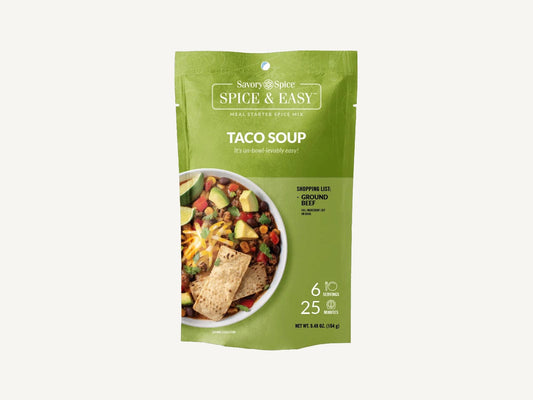
If taco soup is a regular in your dinner rotation, our Taco Soup Spice & Easy is purpose-built for this seasoning's application. The spices are already calibrated for a soup base rather than adapted from taco meat.
Party dips are also a natural fit. The same quality that makes this taco seasoning good in ground beef makes it an excellent dip base. In addition to our earlier dip recipe, this seasoning is perfect for our Fiesta Guacamole, with 2 tablespoons stirred into mashed avocado, sour cream, and lime juice, then loaded up with corn, jalapeño, diced tomato, or grilled skirt steak as add-ins.
Another favorite recipe from our library where Taco Seasoningreally shines is our Southwestern Egg Rolls with Avocado Ranch Dipping Sauce. Two tablespoons of seasoning go into a filling of rotisserie chicken, Monterey Jack cheese, corn, black beans, spinach, red bell pepper, scallions, and pickled jalapeño. The filling gets rolled into flour tortillas and shallow-fried until golden, and served with a homemade dip of mashed avocado, mayonnaise, buttermilk, and Buttermilk Ranch. It takes the contents of a taco and puts them in a completely different format: the egg roll.
Southwestern Egg Rolls with Avocado Ranch Dipping Sauce
For something with more range, our recipe for street food-style Tikka Tacos uses 1 Tbsp of seasoning alongside our Tikka Masala as a fusion spice paste for the chicken. The earthy cumin and chile bridge the Indian and Southwestern flavor profiles in a way that actually works.
Enchiladas are the natural extension of a taco repertoire. They use the same proteins, but in a different format, and the sauce is what defines the dish. Our Canyon Road Red Enchilada Blend builds a New Mexico-style red chile sauce that works with shredded chicken, beef, or pork. It's a different recipe category from tacos, but if you're cooking Mexican food across the week rather than just on taco night, it belongs in the same pantry section.
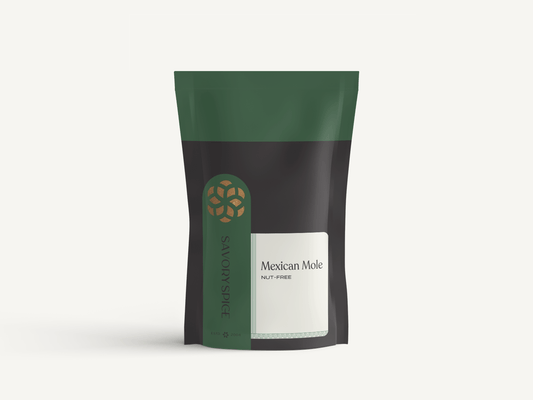
Mole is the more complex end of the same culinary tradition. Our Mexican Mole blend gets into the territory of dried chiles, warm spices, and the bittersweet depth that makes mole one of the most layered sauces in the Mexican canon–simplified into a single (nut-free!) blend. It's not a substitute for taco seasoning, but a natural companion for anyone cooking Mexican food more broadly.
What is the difference between Taco Seasoning and Fajita Seasoning?
The ingredients overlap, but the texture and flavor ratios are different enough that the two seasonings behave much differently when used in cooking.
Taco Seasoning is finely ground–mostly all powders, some minor granules, no chunks. Masa harina makes it a thickener as well as a seasoning. The profile is sweeter and more aromatic, with allspice adding warmth that reads as classically "taco" to most palates. Plus it's designed for a wet application: brown the meat, add the seasoning and water, simmer.
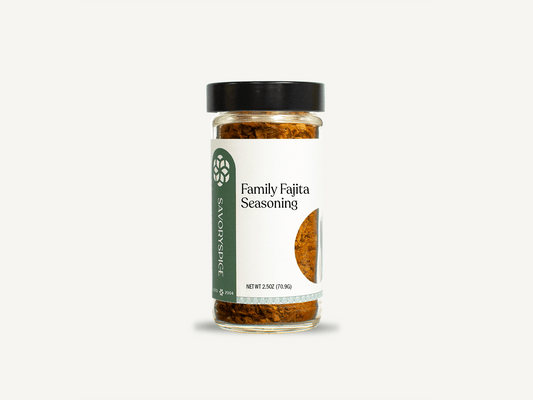
Family Fajita Seasoning is coarser: visible chunks of bell pepper, onion, and garlic. The tomato powder flavor is more forward, the profile is less sweet and more savory-smoky. And it's designed for a dry rub application: coat the meat, grill or sear over high heat. Plus there is no masa harina, so it won't thicken a sauce the same way.
In practice: fajita seasoning on ground beef taco meat won't thicken the way taco seasoning does, and the chunky texture will be more noticeable in the finished meat. Taco seasoning on grilled steak will produce a slightly sweeter crust without the coarse pepper-and-vegetable char of a fajita rub. They're close enough to substitute in a pinch, but they're not the same.
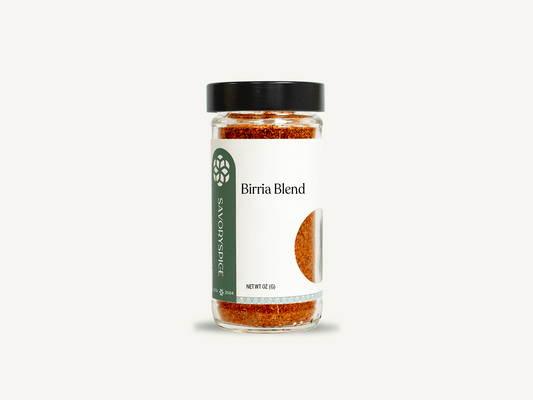
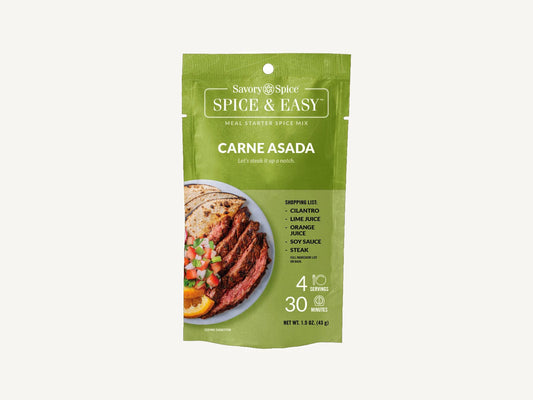
Two other blends in the taco family that might be worth knowing about: Birria Blend and Carne Asada Spice & Easy. Both are also for tacos and in the same flavor neighborhood–Mexican-inspired, chile-forward–but each is purpose-built for a specific technique. Birria is designed for a long, slow braise; Carne Asada is built for a citrus-forward marinade and high-heat grill. They share DNA with taco seasoning but aren't interchangeable with it or with each other. Different tools for different dishes.
The closest swap with taco seasoning is typically fajita seasoning, as it has a similar Southwestern flavor profile that tends to mostly work similarly in flavor on any of the same proteins. It won't thicken the sauce the way taco seasoning does (no masa harina), so ground beef taco meat will be drier and more crumbled than saucy.
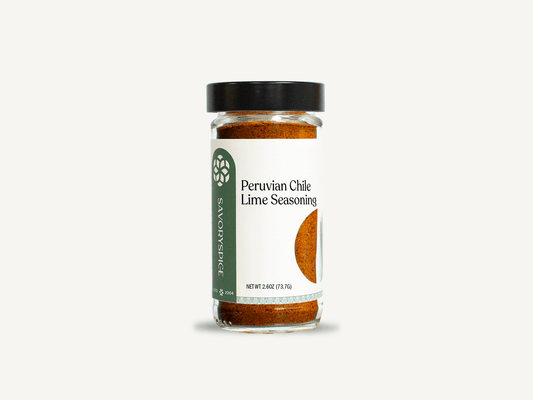
Other substitutes when you're out of taco seasoning: Peruvian Chile Lime Seasoning (it's much more lime-forward, but works well on tacos), El Diente Southwestern Seasoning (similar Southwestern flavor profile, but slightly coarser in blend), or a DIY combination of cumin, chili powder, garlic powder, paprika, salt, and a pinch of dried oregano–though you'll lose the masa harina thickening effect.
For a DIY version of taco seasoning, combine 2 teaspoons cumin, 1 teaspoon chili powder, ½ teaspoon garlic powder, ½ teaspoon paprika, ¼ teaspoon dried oregano, some salt, and a pinch of allspice–that approximates the flavor profile for about 1 pound of meat. What it won't replicate is the inclusion of masa harina. If you have it on hand, stir in a teaspoon with the spice mix and add it with the water as usual; it'll give you the same thickening effect.
The one thing any substitute has a hard time matching is the combination of freshly ground chiles, fresh quality cumin, flavorful chili powder, Mexican oregano, and tomato powder that makes a good taco seasoning taste like itself rather than just "cumin and chili powder." The DIY version gets close enough to finish dinner; it doesn't quite get you there on flavor as much as a jar of this will.