
Curry Powder is a spice blend, not a single ingredient. It's built around a combination of turmeric, cumin, coriander, and ginger, with the specific mix varying by region and tradition. The word comes from the Tamil kari, meaning sauce; the powdered blend was popularized by British colonizers trying to recreate the layered flavors of Indian cooking at home. Today it spans an enormous range: earthy Indian-style yellows, citrusy Thai greens and reds, lemongrass-forward Southeast Asian blends, and European-influenced variations. No single jar tells the whole story.
Behind the Seasoning: Curry Powder
Test Kitchen |

What is Curry Powder?
The first thing to understand about curry powder is that it's a British invention, not an Indian one. Cooks in India have long used a masala dabba–a spice tin holding five to seven individual spices–to compose a different blend for every dish. The idea of a single, pre-mixed "curry powder" didn't exist in traditional Indian home cooking; it was created by British traders and colonizers who wanted a convenient shorthand for the complex spiced sauces of South Asian cuisine.
The base of most yellow curry powders (turmeric, cumin, coriander, ginger, fenugreek, mustard, and black pepper) reflects the spices most commonly used together in South Indian cooking. Turmeric provides color and earthy depth; cumin and coriander handle the warm aromatic base; ginger and black pepper add heat; fenugreek contributes bittersweet depth; mustard brings a sharp, pungent bite. Most good curry blends use 10-15 ingredients. Ours use similar counts, all sourced as individual spices and blended in-house.
Mild Yellow Curry Powder is as approachable as yellow curry gets. It's sweet-spiced, gently earthy, with no heat at all. It contains coriander, turmeric, ginger, fenugreek, anise, cumin, Saigon cinnamon, black pepper, yellow mustard, mace, and cardamom. There's no added salt, no garlic, no onion, which makes it useful for allergy considerations and a clean base for adding your own heat and seasoning.
Medium Yellow Curry Powder takes the same base and adds cayenne, building a moderate kick without changing the overall character. It's the more versatile everyday option that's enough warmth to register without limiting where you use it.


Madras Curry Powder comes from the cooking tradition of Chennai, formerly called Madras, and has a noticeably different character from standard yellow curry: earthier, more peppery, with a roasted quality and subtle warm citrus notes. The ingredient list centers on coriander, cumin, black pepper, yellow mustard, turmeric, and ginger, with the addition of curry leaves. The dried leaf of the curry leaf tree, unrelated to curry powder itself, that adds an aromatic quality central to South Indian cooking. It's the most regionally specific of the three.
What Does Curry Powder Taste Like?
No single note dominates a well-made curry powder.
You should be able to sense the earthiness of turmeric underneath the warmth of cumin and the brightness of coriander, but none should push the others aside. Fenugreek can add a faintly bittersweet undertone; mustard contributes a subtle sharpness; ginger and black pepper bring background warmth. The overall effect is layered and complete: savory, earthy, warm-spiced.
What curry powder does not inherently taste like is hot.
The heat level depends entirely on which type you're using and what's in it. Our Mild Yellow Curry Powder has zero heat. While our Medium Yellow Curry Powder adds cayenne for a moderate kick.
Thai green and red curry varieties can run significantly hotter. When people say "curry is spicy," they usually mean a particular restaurant dish or a specific Thai blend, not the category as a whole.
What varies most dramatically between types of curry is the citrus and herbal character. Indian-style yellow curries are earthy and warm. Southeast Asian–style blends often feature lemongrass, makrut lime leaves, and galangal–ingredients with a bright, citrusy, almost floral quality that makes them taste nothing like a yellow curry despite being built on some of the same base spices.
What Are the Different Types of Curry Powder?
Our curry lineup spans four distinct families. Here's how they break down.
Indian-Style Yellow Curry
The three yellow curry powders covered above, Mild, Medium, and Madras, are the foundation of the category. If you're cooking for someone new to curry, Mild Yellow is where to start. If you want the most authentically South Indian profile, reach for Madras. Our recipe for Curry Chicken Salad is built around any yellow curry powder you have on hand and works well with Cambodian and Vietnamese blends too. It's a good, low-effort way to taste how the blends actually differ, without having to make a full curry dish.
Curry Chicken Salad
Recipe by Miranda Barnett, Savory Spice Test Kitchen
Elevate a classic summer picnic dish with a dose of curry powder! Keep your kitchen cool by using a rotisserie chicken.
 Quick & Easy Meals
 30-Minute Meals
Yields
6 to 8 servings
Prep Time
10 minutes

Thai Curries
Thai curries are built differently from Indian-style yellows. Traditional Thai curry pastes start with fresh ingredients like galangal, lemongrass, makrut lime, and fresh chiles. That flavor profile shapes our dry Thai blends too.
Thai Green Curry (Salt-Free) is the more herb-forward of the two: earthy, citrusy, and peppery, with a 6-7 out of 10 in heat level. It contains green and red chiles, galangal, cumin, coriander, shallots, garlic, cilantro, lemongrass, Lampong peppercorns, and makrut lime leaves.

Use this green curry blend to make a 30-minute coconut milk Thai Green Chicken Curry, swappable with tofu for a vegetarian version. Or try our recipe for Green Curry Chicken with Mango, which adds fresh or frozen mango for sweetness and contrast.

Thai Green Chicken Curry
Yields
4 servings
Prep Time
10 minutes
Cook Time
20 minutes
Green Curry Chicken with Mango
Recipe by Adapted from Shelby Kinnaird (aka Diabetic Foodie)
A deliciously sweet and spicy curried chicken with mango and vegetables.
Quick & Easy Meals
 Healthy Cooking
30-Minute Meals
Healthy Cooking
30-Minute Meals
Yields
4 servings
Prep Time
10 minutes
Cook Time
15 minutes

Red Thai Curry is medium-hot, chile-based, and deeply aromatic: Spanish paprika, lemongrass, shallots, galangal, cumin, coriander, Chinese red pepper, red Thai chiles, Lampong peppercorns, cilantro, garlic, makrut lime leaves, California basil, and spearmint. The paprika is doing more here than in most blends. Both the color and a significant part of the heat come from it.

Use this red curry blend to make our recipe for Red Thai Curry Alfredo, a fusion dish that runs the aromatic punch of red Thai curry through coconut milk and tosses it with udon noodles and seared shrimp. It's super creative and worth trying.

Red Thai Curry Alfredo with Udon Noodles and Seared Shrimp
Yields
4 servings
Prep Time
10 minutes
Cook Time
20 minutes
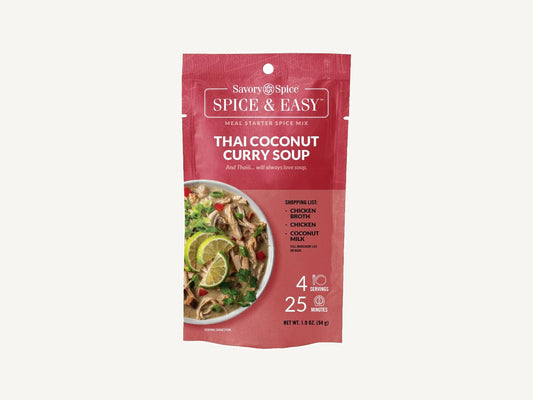
Thai Coconut Curry Soup is our Tom Kha Gai dry mix and a consistent top seller. It's a complete coconut curry soup kit, with dehydrated shiitake mushrooms, red bell pepper, lemongrass, galangal, makrut lime leaves, and a coconut milk base. It's ready in 30 minutes and makes up to 4 servings. Citrusy, aromatic, earthy, with a low-medium heat level and a sweet umami depth from the mushrooms. It's the fastest way into Thai curry flavor from a standing start.
Southeast Asian Blends
Between Indian-style yellow and Thai, there's a third group: blends from Vietnamese and Cambodian cooking traditions that share the lemongrass-forward, citrusy character of Thai curry but with their own distinct profiles.
Vietnamese Sweet Lemon Curry is the most distinctive of the lineup: noticeably sweet from white sugar in the blend, brightly citrusy from lemongrass and citric acid, and lighter in its earthy spice character than either yellow or Thai curry. It's one of our only curry blends that includes sugar as an ingredient. The sweetness means it needs a little acidity or heat to balance, which is why coconut milk and lime come up frequently in the recipes alongside it.

If you need inspiration, try our recipe for Vietnamese Sweet Curry Roast Chicken. It's a 6-to-12-hour yogurt marinade recipe developed by a Thai restaurant chef that caramelizes into a sticky, aromatic crust during roasting.

Vietnamese Sweet Curry Roast Chicken
Yields
4 servings
Prep Time
10 minutes
Cook Time
1 hour 30 minutes
Cambodian Lemongrass Curry is zestier and more savory than Vietnamese, without the sweetness. Mild green chile powder, lemongrass, shallots, salt, garlic, onion, Lampong peppercorns, galangal root, ginger, makrut lime leaves, red Thai chilies, and citric acid. It's a medium-heat blend with the clean brightness of lemongrass as its defining note.
One of our founders developed a recipe specifically around it: Cambodian Lemongrass Chicken Curry. It's a simple stovetop curry with coconut milk, chicken, and frozen Asian vegetables that comes together faster than most weeknight meals.
Recipe by
Specialty and Global
Two blends occupy their own category in the curry space that are neither traditionally Indian nor Thai, but both built on the same spice architecture.
Vindaloo comes from Goa, a former Portuguese colony on India's west coast, and the European influence shows in its warm-spiced curry character: Saigon cinnamon, cloves, and cardamom alongside the more expected curry components of turmeric, cumin, coriander, ginger, fenugreek, brown mustard seeds, garlic, salt, cayenne, and black pepper. Vindaloo has a reputation for intense heat; we've calibrated ours to mild-to-medium, which means the cinnamon-forward warmth and fragrant cloves read clearly rather than being buried under fire.

Chicken Vindaloo
Yields
4 servings
Prep Time
10 minutes
Cook Time
30 minutes
Vadouvan takes a different path entirely. It's French-style curry rooted in the masala tradition of Pondicherry: a former French colonial territory on the southern Indian coast. The French influence is unmistakable: shallots, garlic, and fenugreek slow-roasted before drying, producing a masala with caramelized, slightly smoky depth that no other curry powder has.
Ours contains onion, shallots, cumin, turmeric, garlic, brown mustard, cardamom, black pepper, fenugreek, and hickory smoke flavoring. It's aromatic and delicate. Add it toward the end of cooking rather than at the start, and it works in applications most people would never think to reach for a curry powder: stirred into compound butter, tossed over roasted cauliflower, whisked into a salad dressing, spread on crostini.


How Do You Cook with Curry Powder?
The most important technique for any curry powder is blooming: adding the spice to hot fat before any liquid goes into the pan. A brief 30-60 seconds in hot oil or butter unlocks the fat-soluble compounds that give curry powder its depth and aroma.
Skip this step and add the powder directly to a sauce or liquid and the flavor stays flat, the color muddy. Get it right and the spice integrates into the entire dish rather than sitting on top of it.
For stovetop curries: Start with aromatics–onion, garlic, ginger–in hot oil, then add your curry powder when the aromatics are soft and fragrant. Let it bloom for 30-60 seconds, then add coconut milk or stock. One to two tablespoons of curry powder per can of coconut milk is a reliable starting point; adjust from there.
As a paste: Equal parts curry powder, water, and a neutral oil stirred into a thick paste gives you better control and more even distribution than adding the dry spice to a hot pan. This is especially useful for marinades and for quick-cooking coconut milk curries. The paste can be made a few days ahead and held in the fridge.
As a marinade: The Vietnamese Sweet Curry Roast Chicken recipe uses lemon curry in a yogurt-and-oil marinade applied overnight (6 to 12 hours). The yogurt tenderizes while the curry spices penetrate deeply; during roasting, the marinade caramelizes into a sticky, aromatic crust. The same approach works for any curry powder in the lineup — an overnight yogurt or oil-based marinade transforms both flavor and texture on chicken, lamb, and firm fish.
For Thai-style dishes: The Red Thai Curry Alfredo and Thai Green Chicken Curry both follow the same logic: bloom in oil, add coconut milk, build the sauce, finish with protein and vegetables. The main adjustment for Thai blends is a slightly longer bloom time: the lemongrass and galangal components release their flavor more gradually than finely ground Indian-style spices.
How much curry powder to use:
- 1 tablespoon per pound of protein for a marinade;
- 1 to 2 tablespoons per can of coconut milk for a sauce-based curry;
- ½ teaspoon per serving for soups where curry is one of several flavor notes.
- Vadouvan is the exception. Use it sparingly, and add it near the end of cooking.
What Else Can You Make with Curry Powder?
The most underused application for curry powder is anything that doesn't involve a hot sauce. Cold preparations let the spice's complexity work differently, without the heat of the pan softening the aromatic edges.
Curry Chicken Salad is the easiest starting point: rotisserie chicken, mayonnaise, Dijon mustard, and whatever curry powder is on your counter. It's a low-effort way to taste how different the blends actually are when nothing else is competing with them. And you can try it in other recipes, not just chicken salad!
Caribbean Curry Shrimp pairs our Barrier Reef Caribbean Mix with sweet lemon curry, and the two complement each other's sweetness and citrus notes in a 20-minute shrimp dish with bell peppers, jalapeño, and tomatoes.

Caribbean Curry Shrimp
Yields
4 servings
Prep Time
10 minutes
Cook Time
10 minutes
There are also two other Indian-style blends worth knowing alongside the curry powders above aren't technically curry powders: they're masala-style blends. But, they belong in the same conversation and on the same shelf.
Tikka Masala (Salt-Free) is a sweet-spiced, peppery blend built around Spanish paprika, cumin, coriander, ginger, chiles, garlic, turmeric, black cardamom, and charnushka. It's named after tikka masala, the creamy tomato-based curry that became one of Britain's most popular restaurant dishes. It serves as a shortcut to that flavor profile.
Featured recipe: Halloumi Tikka Masala, a vegetarian version using grilled halloumi in a tomato-cream sauce.
Halloumi Tikka Masala
Recipe by Michael Kimball, Savory Spice Test Kitchen
Unlock layers of flavor by toasting whole spices in this rich, silky, vegetarian curry.
 Global Cuisines
 DIY Takeout
Yields
4 servings
Prep Time
20 minutes
Cook Time
1 hour

Tandoori Masala Seasoning (Salt-Free) captures the earthy, peppery, warm-citrus character of tandoor-style cooking: cumin, coriander, smoked sweet paprika, turmeric, garlic, Guajillo chiles, ginger, charnushka, black and green cardamom, black pepper, cloves, mace, Saigon cinnamon, and Turkish bay leaves. It carries a smoke note from the Guajillo and smoked paprika that sets it apart from the curry powders above.
Featured recipes: Matar Paneer. You use either homemade or store-bought paneer with peas in a spiced tomato sauce. Or we recommend trying our recipe for Curry Cauliflower with Crispy Chile Tofu.

Matar Paneer
Yields
4 to 6 servings
Prep Time
30 minutes
Cook Time
20 minutes
Curry Cauliflower with Crispy Chile Tofu
Recipe by Savory Spice Test Kitchen
Cauliflower is perfect for curry. This cauliflower curry recipe features citrusy warmth from Tandoor...
 All-Purpose Cooking
Quick & Easy Meals
Healthy Cooking
30-Minute Meals
All-Purpose Cooking
Quick & Easy Meals
Healthy Cooking
30-Minute Meals
Yields
4 servings
Prep Time
5 minutes
Cook Time
25 minutes


Garam Masala completes the set. Where curry powder is bloomed in fat at the start of cooking to build the flavor foundation of a dish, garam masala works the opposite way! it's a finishing spice, added in the last few minutes to preserve its fragrant, aromatic character. It contains no turmeric, so it doesn't color a dish the way yellow curry does; its profile runs toward cinnamon, cardamom, cloves, and cumin — warm and aromatic rather than earthy and grounding. Think of it as the layer that lifts a dish at the end rather than the base built into it at the beginning. It's the blend you'll reach for when making tikka masala from scratch.

What Can You Substitute for Curry Powder?
For yellow curry powder: The closest approximation from pantry staples is a 2:1:1 blend of ground turmeric, cumin, and coriander, with ground ginger, mustard powder, and black pepper if you have them. This won't replicate the full depth of a blended curry powder (the fenugreek's bittersweet undertone will be missing), but it gets you to the same general color and warmth. Use this as a starting point and adjust to taste.
For Thai curry: The flavor profile of Thai green or red curry–galangal, lemongrass, makrut lime–is specific enough that there's no clean approximation from pantry staples. The most practical substitute is another Thai blend: red Thai curry for green, or vice versa. Expect a shift from herbaceous and citrusy to chile-forward, but the coconut milk base and overall structure of the dish will hold. Our Cambodian Lemongrass Curry can also stand in for Thai green in dishes where lemongrass is the defining note.
For Madras or a complex Indian-style curry: Garam Masala is the closest related blend, though it's warmer and more aromatic (heavier on cinnamon, cloves, and cardamom) and lacks turmeric's color. Combine garam masala with ground turmeric– roughly 3 parts masala to 1 part turmeric–for a reasonable approximation of the color and warmth.
Swapping one type for another: Yellow curry and Thai green curry will produce dramatically different results in the same recipe. Within a family, any yellow for another yellow, any Thai for another Thai, the swap usually works with expected flavor shifts. When a recipe specifies a particular type, match the family first. The exact blend matters less than the broad category.
Previous article
Previous Article
Behind the Seasoning: Turmeric
Next article
Next Article
Behind the Seasoning: Turmeric
2 Comments
Hi James – Curry Powder isn’t a substitute for salt & pepper and will definitely give you a much different flavor. However, it can be used to season a variety of dishes. For example, you could add curry powder into mayo/dressing when making chicken salad or add to marinades for meat when you’re looking for a little more flavor. We also have a bunch of recipes that use curry powder if you’re still not sure what to do with it. Hope that helps.
Savory Spice 06/03/2024
I’m confused about yellow curry. Can I use it like salt & pepper?
James D'Arcangelo 06/03/2024
Leave a comment
Join our community
Join our email list and Loyalty Club to earn points and save 10% on your first order!