Thyme is one of the oldest cultivated herbs on earth and one of the most universally used. It turns up in French mother sauces, Mediterranean herb blends, Middle Eastern za'atar, and Thanksgiving stuffing.
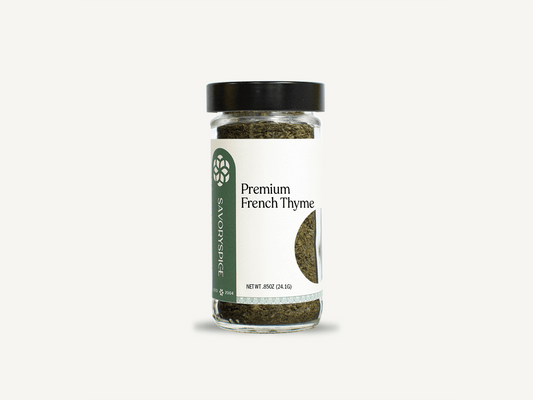
That range isn't an accident. Thyme has an earthy, slightly peppery warmth that deepens other flavors without dominating them, which is exactly what makes it useful across cuisines and cooking methods. It's the herb that makes a braise taste deeper, a stuffing more savory, and a simple roast chicken worth making again. Our Premium French Thyme is darker and more aromatic than standard dried thyme, and once you've cooked with it, the difference is obvious.
French Thyme (Thymus vulgaris) is the most widely used culinary variety, but not all dried thyme sold under that name is the same. Standard dried thyme—the kind in most grocery store jars—is typically a blend of Mediterranean varieties: pale green, milder, with a lighter aroma.
French thyme proper has darker green leaves, a stronger, more pungent aroma, and a slightly bitter finish that gives it more presence in a dish. And our Premium French Thyme fits the traditional profile: deep, dark green with a robust earthy scent. It's the variety that French cooking was built on—bouquets garnis, braises, mother sauces—and the one that holds up when you need the herb to actually contribute flavor rather than just add color to the jar.
The practical difference: if a recipe asks for thyme and produces a result that tastes faint or thin, generic dried thyme is often the reason. A higher-quality French thyme at the same quantity delivers noticeably more.
What does thyme taste like?
Thyme has a warm, earthy flavor with a faint peppery quality and a subtle minty undertone. It's savory and herbal, not sharp, not sweet, not floral. The flavor is quieter than rosemary or oregano, which makes it one of the most versatile herbs in the kitchen: it rounds and deepens other flavors without announcing itself.
Raw dried thyme has a clean, slightly vegetal quality. Heat changes it—in a long braise or slow-cooked sauce, the earthy notes deepen and the peppery edge softens into something more rounded and complex. This is part of why thyme is so central to French cooking: it behaves well over time, opening up gradually rather than burning off the way more delicate herbs would.
The variety affects flavor too. Standard Mediterranean or common thyme is mild and grassy. Lemon thyme carries a citrus note. But our Premium French Thyme sits at the more aromatic, slightly bitter end of the spectrum. It's deeper green, stronger scent, more concentrated flavor.
Is fresh or dried thyme better?
Both are legitimate, and the right choice depends on the cooking method rather than any general rule about fresh being superior. Fresh thyme is brighter and slightly more peppery, with a clean herbal note that dried thyme doesn't have. It's best used where that brightness matters–scattered over a dish right before serving, stirred into a vinaigrette, tucked under the skin of a chicken going into the oven so the leaves crisp in the fat. Fresh sprigs are also useful in dishes where the herb is removed before eating, like a braise or stock, since the whole sprig is easy to fish out.
Dried Thyme is more concentrated, earthier, and holds up better in long-cooked applications. When thyme goes into a sauce that will simmer for an hour or a stuffing that will bake for 45 minutes, dried does the job better. It infuses slowly rather than dissipating. Most savory recipes that call for dried thyme were developed for dried thyme, and substituting fresh without adjusting the amount often produces an underpowered result.
The standard conversion: use 1 tsp of dried thyme for every 1 Tbsp of fresh thyme. In other words, dried is roughly three times more concentrated than fresh.
How do you cook with thyme?
Thyme is one of the foundational herbs of French cooking, and the technique that best demonstrates why is the "bouquet garni"—a small bundle or sachet of herbs (typically thyme, bay leaf, and parsley stems) tied together or tucked into a muslin bag and added to braises, stocks, and long-simmered sauces. The herbs slowly release their flavor into the liquid, then the sachet is removed before serving.
Both of our French mother sauce recipes use this technique: our recipe for Sauce Tomat (the classic French tomato sauce, simmered for up to two hours until slightly sweet and thickened) and our recipe for Espagnole Sauce (the rich brown mother sauce built on a dark roux, beef broth, and Tomato Powder) both call for thyme, bay leaf, and parsley in a sachet.
If you want to understand how thyme functions in classical cooking, these two sauces are the place to start. The herb isn't tasted directly, but the depth it adds to the sauce over a long simmer is unmistakable.
In one-pot cooking, thyme goes in early. It's added directly to the cooking liquid so it has time to bloom. Our recipe for a Vegan Pot Pie uses 1 tsp ofPremium French Thyme stirred into the filling alongside the broth and vegetables, simmering for 15 minutes before it all goes under the crust. The thyme is the backbone of the filling's savory flavor. Without it, a vegetable pot pie can taste flat no matter how good the crust is. The same principle holds for any one-pot braise: thyme in early, let it work.
Stuffings are a classic application for the same reason. Thyme and sage are one of the oldest herb pairings in European cooking, and our recipe for Cornbread Stuffing uses both: 1 tsp of Premium French Thyme and 1 tsp of Rubbed Sage cooked down with the vegetables (onion, celery, bell peppers, green onion, garlic) for a full 30 minutes before the cornbread and broth go in. That long sauté is what builds the flavor base. Don't shortcut it. The recipe makes a stuffing worth making in July, not just November.
Cornbread Stuffing
Recipe by Savory Spice Test Kitchen
What's Thanksgiving without the stuffing? This creative spin on a classic holiday side dish has moist cornbread and...
For egg dishes and savory baked applications, thyme holds up better than most people expect. Our recipe for Steak and Potato Crusted Quiche whisks 1 tsp of Premium French Thyme directly into the egg and cream mixture alongside Minced Lemon Zest and Mayan Sea Salt, then bakes it over a crust of thinly-sliced Yukon Gold potatoes. The thyme's earthy warmth plays particularly well against the richness of eggs and cream. It functions the way it does in French quiche tradition, grounding the custard and adding a savory complexity that makes it feel like a real dish rather than just eggs in a pan.
Beyond the recipes: a few sprigs of fresh thyme tucked under the skin of a whole chicken before roasting will crisp in the fat and perfume the meat throughout. Thyme stirred into a compound butter with garlic and lemon peel makes a fast finishing butter for steak or vegetables. A teaspoon of dried thyme in a homemade vinaigrette adds an herbal backbone that store-bought versions rarely achieve.
What goes well with thyme?
Thyme pairs naturally with garlic, lemon peel, rosemary, basil, sage, marjoram, allspice, nutmeg, and cloves. It has particular affinities with pork, chicken, lamb, and white fish—proteins that benefit from the earthy herbal depth thyme adds during cooking. In French cooking, the combination of thyme, bay leaf, and parsley (bouquet garni) is so fundamental it's considered a base, not a garnish.
If you'd rather reach for a blend than layer individual spices, thyme is the backbone of several of our blends. Herbes de Provenceis our most thyme-forward. It's a blend built around it alongside savory, marjoram, and rosemary. Za'atar uses thyme as its base herb alongside sumac and sesame, giving it a tangy, earthy character that works on flatbreads, vegetables, and roasted meats. Pizza Herb Topper combines thyme with basil, oregano, and garlic for a blend that does more than its name suggests.
Poultry Seasoning pairs thyme with sage, marjoram, and rosemary. It's the traditional combination for poultry, stuffing, and roasted root vegetables. Italian Herbs brings thyme together with oregano, basil, and rosemary in a workhorse blend that covers most Mediterranean cooking.
Oregano is the closest substitute for thyme. The two herbs are in the same family and share that earthy, slightly peppery quality. Use it 1:1, but expect a slightly sweeter, less bitter flavor. Marjoram is similar to oregano but milder and more floral; it works well in gentler dishes where thyme's earthiness could be too assertive.
Rosemary can substitute for thyme in roasted meat dishes, but it's much more potent and piney–use about half the amount and taste as you go. Tarragon is an option in French-inflected dishes where the anise note won't feel out of place.
For blend substitutes: if a recipe calls for dried thyme and you're out, any blend that contains thyme will work depending on context. Italian Herbs, Za'atar, Herbes de Provence, and Poultry Seasoning all contain thyme as a primary ingredient and share a similar herbal profile.
The right pick depends on the dish: Poultry Seasoning for anything with chicken or turkey, Herbes de Provence for anything French or Mediterranean, Za'atar if a slightly tangy, sesame-forward note fits the application.