Chile heat is a spectrum, from mellow and fruity with barely any burn to genuinely incapacitating.
The difference between an Ancho and a Ghost Pepper isn't just intensity; it's flavor character, best use, and what you're actually asking a dish to do. This guide on chil e heat covers the science behind why chiles are hot, how the Scoville scale works, and where each chile product we carry falls on that range. That way, you can choose the right level of heat with intention instead of guesswork.
Why are chiles hot?
"Spicy" isn't a taste. It's a sensation, and the distinction matters for understanding why different chiles hit differently and why dairy cools heat faster than water.
The compound responsible is capsaicin, found in all chile peppers. Capsaicin doesn't bind to the taste receptors on your tongue. Instead, it binds to TRPV1 receptors: pain receptors designed to detect heat and physical burning. When capsaicin activates those receptors, your brain reads a genuine heat signal.
From your nervous system's perspective, the difference between touching a hot pan and biting a ghost pepper is a matter of degree, not type. The burn is real even though no tissue damage is occurring.
Capsaicin is concentrated in the pith, the white ribbing inside the chile fruit where the seeds are attached. The flesh and skin carry some capsaicin, but the pith holds the highest concentration. Seeds pick up heat primarily from contact with the pith, not from containing capsaicin themselves. This is why removing the pith and seeds from a fresh chile reduces heat substantially.
Why do chiles produce capsaicin at all? It's an evolutionary mechanism that works with remarkable precision: mammals, which grind seeds in digestion and destroy them, are deterred by the burn. Birds, which swallow chiles whole and disperse seeds intact, are genetically immune to capsaicin. The plant's seeds get spread by exactly the right animals. That selective deterrent, developed over millions of years, became one of the defining flavor categories in human cooking.
One more reason humans keep choosing heat: capsaicin triggers endorphin release. The brain responds to the pain signal by flooding the system with natural painkillers that produce a mild euphoric effect. The more you eat hot food, the more the body recalibrates its sensitivity, which is why regular hot-food eaters genuinely experience milder chiles as less intense over time.
"Cultures outside of the Americas haven't had chiles all that long," explains our co-founder, Mike Johnston.
The cuisines most associated with serious heat today—Thai, Indian, North African, Middle Eastern—didn't even have access to chile peppers until the late 15th century, when Columbus's voyages set off the Columbian Exchange. By 1550, chiles had reached Western China, Southeast Asia, and the East Indies. The speed of that spread says everything about what chiles offered: they adapted to new climates easily, integrated into existing cuisines almost immediately, and delivered a flavor impact nothing else could replicate. What feels ancient and deeply rooted in countless food traditions around the world was built in a remarkably short window
How does the Scoville scale work?
The Scoville Heat Unit (SHU) scale was developed by pharmacist Wilbur Scoville in 1912. His original method was sensory: a panel of five trained tasters sampled increasingly diluted extracts of a given chile until the heat was no longer detectable. The level of dilution required became the SHU measurement: a jalapeño pepper at 5,000 SHU means its extract had to be diluted 5,000 times before testers could no longer detect the heat.
Modern measurement uses high-performance liquid chromatography (HPLC), which directly measures capsaicinoid concentration in a lab rather than relying on human perception. The numbers are more precise, but the old Scoville panel method had something the chemistry can't fully replicate: it accounted for the human experience of heat, not just the molecular concentration.
The scale runs a very wide range:
Bell Peppers: 0 SHU (no capsaicin)
Jalapeño: roughly 2,500-8,000 SHU
Cayenne: roughly 30,000-50,000 SHU
Habanero: roughly 100,000-350,000 SHU
Ghost Pepper: roughly 800,000-1,000,000 SHU
Pepper X (current record): over 3,000,000 SHU
A few important caveats: SHU numbers describe potential, not guaranteed experience.
Heat levels vary within the same variety depending on growing conditions like soil, sun exposure, water stress, ripeness. A jalapeño can range from barely warm to genuinely hot depending on how it was grown. The SHU for any given chile is a representative average, not a fixed value.
The numbers are also linear while the sensation is not. The difference between 5,000 SHU and 50,000 SHU feels far more dramatic than a factor of 10 would suggest. The jump from medium to high heat is experiential, not mathematical.
What chiles have mild or medium heat level?
The lower half of the Scoville scale (roughly 0 to 10,000 SHU) is where flavor complexity tends to be highest relative to heat. These chiles bring genuine character to a dish: fruitiness, earthiness, smoke, sweetness. Heat is present but secondary.
Ancho is a dried poblano and one of the foundational chiles in Mexican cooking. At 1,250 SHU, it brings almost no heat. What it brings instead is depth: raisiny, chocolatey, earthy, with a slight sweetness that carries well in long-cooked sauces and moles. If someone in your household can't handle heat but you want real chile flavor in a dish, ancho is your tool. Its mild heat and dark, complex character also make it one of the most useful chiles for blending. It's the base of most commercial chili powder formulations for exactly this reason.
New Mexican chiles are a regional variety developed in the Hatch Valley of New Mexico, distinct from generic cayenne or chili powder in their earthy, slightly sweet, clear chile flavor. The mild version delivers that character with minimal heat, which is just enough warmth to register without building. It's good in enchilada sauces, stews, and anywhere you want the flavor of red chile without the fire.
Guajillo has a bright, tangy quality (it's almost cranberry-like) with a clean, moderate heat that rises and fades quickly rather than lingering. At 3,750 SHU it's firmly in mild territory with enough presence to be interesting. Guajillo is one of the most versatile chiles in Mexican cooking: it forms the base of countless adobos, birria broths, and enchilada sauces. Its bright, slightly fruity acidity cuts through fatty meats well.
Hatch green chile powder is ground from roasted Hatch green chiles — the variety grown in the Hatch Valley of New Mexico with a flavor profile unlike any other green chile. Earthy, slightly sweet, with a clean vegetable character and a warm, building heat that falls in the lower-medium range. This is the roasted green chile flavor of New Mexican cooking in dried form. For more, go Behind the Seasoning: Hatch Green Chile.
The hot version of the New Mexican red chile delivers the same clear, earthy, regional flavor at a noticeably elevated heat level. At 5,000 SHU it's moderate, but it's warm enough to build across a dish but not a heat experience in its own right. The character is the same as the mild version; the heat is the variable.
Chipotle is a smoked dried jalapeño—the Morita variety, specifically, which is a smaller, fruitier chipotle than the more common Meco. The smoke is the defining characteristic, deep and persistent, paired with the moderate jalapeño heat that makes up its base. At 5,250 SHU it's right at the top of the medium range. Chipotle powder is a one-ingredient flavor transformation for grilled meats, barbecue sauces, and anything that benefits from smoky heat. Its flavor is so distinct that it reads as more intense than the SHU number would suggest.
Ground dried jalapeño at 5,250 SHU is basically the same heat level as the Chipotle (Morita), since chipotle is just a smoked jalapeño. The dried powder form concentrates the jalapeño's bright, grassy, slightly vegetal heat in a way the fresh version doesn't quite achieve. Good for seasoning where you want that recognizable jalapeño character without the moisture of a fresh pepper.
What chiles have medium-hot to high heat?
Above 10,000 SHU the heat starts to become part of the flavor experience rather than a background note. These chiles can still bring significant complexity (Aleppo and Urfa in particular are prized for flavor as much as heat), but the burn registers more clearly and persists longer.
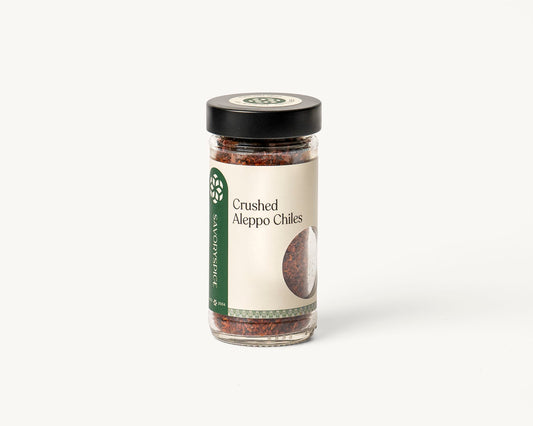
Aleppo pepper is a Syrian chile named for the city of Aleppo, and it's one of the most characterful chiles at any heat level. The flavor is fruity, slightly oily, with a gentle heat that builds slowly and a faint raisin-like sweetness. It's nothing like the sharp heat of cayenne or the smoke of chipotle. At 10,000 SHU it's warm but not hot, and it's one of the most misunderstood chiles in the pantry: cooks who reach for red pepper flakes for everything are missing what Aleppo actually does. It melts into dishes rather than punctuating them, and it belongs on everything from eggs to pasta to roasted vegetables. The coarse crush (it's never ground to a fine powder) gives it a bit of texture in addition to heat.
Standard crushed red pepper flakes are the workhorse of the chile pantry. They're familiar, flexible, and present in nearly every kitchen. At 13,750 SHU they bring medium-high heat that reads as sharp and quick rather than complex. The flavor is hot before it's anything else. That's not a flaw; it's a function. Red pepper flakes are the right tool when you want heat added efficiently without altering a dish's other flavor character. From pizza and pasta to stir-fries and braises, the flakes are there for heat with a light hand on flavor.
Urfa biber is a Turkish chile that undergoes a distinctive processing method. They're dried during the day, wrapped at night to trap moisture, and that produces a uniquely dark, oily, fruity-smoky character unlike any other dried chile. At 30,000 SHU it sits well into the warm-to-hot range, but the heat is slower and more lingering than the number suggests because the natural oils in the chile moderate how quickly capsaicin hits. The flavor has been described as chocolate, tobacco, and dried fruit. It's dark and complex in a way that makes it particularly good with lamb, eggplant, chocolate, and anything needing savory depth without sharp heat.
Cayenne is the benchmark for straightforward, versatile heat. At 40,000 SHU it's genuinely hot, to the point where heat becomes the primary sensation rather than a supporting note. But, its flavor is clean and relatively neutral compared to the more characterful chiles below it on the scale. That neutrality is the point: cayenne adds heat without imposing a competing flavor profile. It works in virtually every cuisine and every format. For more on its flavor, varieties, and uses across cuisines, go Behind the Seasoning: Cayenne.
The jump from cayenne to habanero is one of the most dramatic on the scale. From 40,000 to 225,000 SHU, nearly a six-fold increase. Habanero brings not just significantly more heat but a fruity, slightly floral flavor that makes it distinct from the cleaner heat of cayenne. It's the chile that comes with both a flavor personality and a genuine burn. Use habanero in small amounts as a flavoring and heat source together, not as a neutral heat addition. Its fruit character pairs well with tropical dishes like mango salsas, Caribbean preparations, anything that can take both the sweetness and the fire.
The upper end of the Scoville scale is its own category. It's less of a culinary tool, more endurance test. These chiles are used in tiny, precise quantities for maximum heat with minimal volume.
Ghost pepper was the world's hottest chile from 2007-2011 and still carries the cultural weight of that title. At 950,000 SHU, it's in a different class than anything below it. The heat is overwhelming in any quantity greater than a small pinch, and it builds for several minutes after contact. The flavor underneath the heat is smoky and slightly chocolatey. It's a combination that makes it interesting for sauce makers and heat enthusiasts willing to work with extreme caution. A tiny quantity goes a very long way.
If you want ghost pepper heat in a format that works as a finishing element rather than a cooking ingredient, Ghost Pepper Salt brings the same intensity to a gourmet sea salt. It's infused through a liquid binding process, so every salt granule carries the heat. The more surprising detail is the binder: chocolate extract. It doesn't make the salt taste like chocolate; it provides an aroma that primes the palate before the heat arrives, which makes the impact land more cleanly than it otherwise would. (Chocolate and chile are a classic pairing for exactly this reason. The bitterness in chocolate tempers the sharpness of the burn). Use it as a finishing salt on fruit, a cocktail or michelada rim, wings, fries, eggs, or anywhere you want ghost pepper heat applied with precision rather than cooked into a dish.
Beyond ghost pepper, Carolina Reaper (roughly 1.5–2 million SHU) and Pepper X (over 3 million SHU) represent the current upper limit of documented chile heat. These exist as hot sauce ingredients and competitive eating challenges more than kitchen staples, but they illustrate where the scale actually ends, and it keeps moving as breeders push further.
What is chili crisp, and how is it different from chile paste and whole chiles?
Not every form of chile heat comes in a jar of dried powder. Chili crisp, chile paste, and whole chiles packed in sauce each use the heat and flavor of chiles differently. They're also worth knowing about as distinct formats with distinct applications.
The chili crisp trend (crunchy, oily, garlicky, spicy condiments like Lao Gan Ma and the now widely available "chili crunch" category) created one of the most craveable flavor combinations in modern pantry culture: the crunch of fried aromatics, the depth of dried chiles, the heat of red pepper, all suspended in fragrant oil.
OurGarlic Chile Crunch is a dry-blend version of that concept. The crunchy texture and layered chile-garlic flavor without the oil, in a format you can sprinkle, cook with, or stir into anything. Red and green bell chiles, roasted garlic, jalapeño, New Mexican red chile powder—warm, textured, and versatile where traditional chili crisp requires a spoon and a mess. Use it anywhere you'd use chili crisp oil: noodles, fried rice, eggs, avocado toast, pizza, grilled proteins.
Chipotle Chiles in Adobo Sauceare a pantry staple in Mexican and Tex-Mex cooking. Whole smoked jalapeños (chipotles) packed in a thick, mildly spicy tomato-based sauce and canned. The adobo sauce itself carries the flavor of the chiles; the chiles carry the smoke. They rate about a 5-6 on a 1-10 heat scale, which means they're moderate, accessible, and deeply savory rather than sharply hot. The biggest advantage over chipotle powder: texture. A whole chipotle blended into a sauce gives body and depth. Minced, it distributes heat and smoke through a dish. Left whole and added to a long braise, it infuses without overpowering. Pull it out before serving for mild heat or leave it in and let diners find it. Unused chipotles keep refrigerated in a sealed container for a couple of months.
Calabrian Hot Pepper Paste comes from the Calabria region of southern Italy, where they're considered one of the most important ingredients in the local kitchen. Hot, fruity, slightly smoky, with a peppery intensity that sits noticeably above jalapeño heat but below cayenne. Calabrian peppers are in a similar heat range to Aleppo or red pepper flakes, but their flavor character is distinctly Mediterranean rather than Middle Eastern or generic. Bomba di Calabria is the classic form: a paste that stirs into sauces, pasta, pizza, eggs, dressings, or marinades with immediate depth and controlled heat. The olive oil carries the fat-soluble flavor compounds; the vinegar adds brightness. Small amounts bring significant impact. Refrigerate after opening.
What are some hot spice blends that are made with dried chile peppers?
"What makes for a great spicy sauce or seasoning is chile peppers—and in the grand scheme of things, cultures outside of the Americas haven't had them all that long." - Mike Johnston, co-founder
The same Columbian Exchange that sent chiles racing across continents in the 1500s also set the stage for every one of the seasonings below. Each started as a sauce or condiment rooted in a specific place and culture. Each became a dry seasoning.
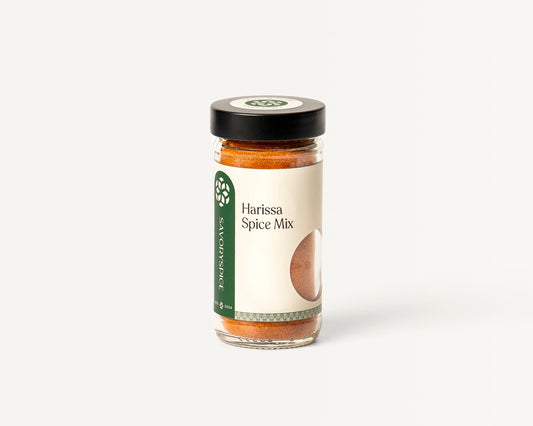
Of all the spicy seasonings in our lineup, Harissa Spice Mix has been with us since the spice shop opened in 2004. Traditionally, it's a spicy chile-based condiment that is a staple in North Africa and throughout the Middle East. It's believed to have originated in the area now known as Tunisia during the Spanish occupation of the region in the mid-to-late 1500s. The name comes from the Arabic verb harasa, meaning "to pound" or "break into pieces." The most basic version of harissa is as simple as crushed chiles, salt, and oil. For a more complex sauce version, try it as a Rose Harissa—a floral derivative built around rose petals that's common across North Africa.
While Columbus is credited with introducing chiles to Europe, it was the Portuguese who spread them far and wide. Their dominance of trade routes meant chiles traveled with colonialism to Africa and Asia, and few chiles took root as completely as African Bird's Eye chiles, the fiery pepper behind Piri-Piri Seasoning. Bird's Eye chiles adapted to the African climate so well they grew wild. The name piri-piri is believed to come from Swahili for pepper-pepper.
Co-founder Mike Johnston developed our blend of piri-piri spices a few years after opening. The first challenge: African Bird's Eye chiles weren't commercially available. After research, he landed on pequin chiles, which is a variety of Bird's Eye that, while not quite as hot, was the right substitute. The rest came together naturally: paprika, salt, lemon peel, garlic, and oregano. To make it into an infused oil, mix 3 Tbsp of the blend with 1 cup of oil, let it sit for a few days, then brush onto chicken while grilling for a spicy, flavorful piri-piri sauce experience.
Buffalo sauce has permeated American food culture over the past 50-plus years like few homegrown flavors have. It can be found on nearly every bar menu, and it's largely responsible for an entire category of specialized wing restaurants. Recreating that tangy, zippy experience in a dry spice blend was a long pursuit for our co-founder Mike Johnston. For years, the flavors just couldn't provide that essential tangy zip. That is, until a dry sriracha chile powder blend ended up on his desk, which lead to the creation of Buffalo Wing Seasoning. It delivers the full experience: that specific combination of vinegary heat, without requiring a bottle of hot sauce.
Aji amarillo chiles are the defining chile of Peruvian cooking. They're a bright, fruity yellow pepper whose character reads as citrusy and tropical rather than hot. It brings warmth, but the flavor leads. Our Peruvian Chile Lime Seasoning builds on that base with makrut lime leaves, Mexican oregano, cumin, paprika, annatto, and cilantro: the full Peruvian flavor profile in a single blend, built around a chile that's more about vibrancy than burn. Use it on chicken, seafood, ceviche, empanadas, or anywhere you'd reach for a chile lime seasoning. This one just goes further on flavor than the category usually does.
And finally, our seasoning blend of Black Garlic Salt contains Korean chile (gochugaru) in its ingredient list, which is yet another example of how deeply chiles are woven into regional traditions. Gochugaru is the medium-heat, fruity-smoky dried chile at the heart of Korean cooking, from kimchi to tteokbokki. In this black garlic seasoning, it contributes an earthy, slightly smoky depth. Worth knowing if you're tracing chile heat across the pantry or cooking for someone with a sensitivity.